“What do engine oil viscosity grades like 0W-40 or 5W-30 mean, and why do older engines need different oil than new ones?”
Oil viscosity explained.
The number before the W is about cold starts, the one after the dash about thickness when hot. Older engines want thicker oil: they were built looser.
The short answer
- The number before the W tells you how cold it can get before the starter can no longer crank the engine and the pump can no longer draw the oil. The number after the dash is a thickness window at 100 °C.
- Two oils with the same grade can differ by about 20 % in a hot bearing. The HTHS value and the carmaker's approval say more than the grade on the bottle.
- Older engines were built with larger bearing clearances and often flat tappets, so they need a thicker film. Modern engines are designed around thin oil and also use it as hydraulic fluid.
Walk past the motor oil shelf in any parts store and the viscosity ratings on every oil bottle read like a code: 0W-16, 5W-30, 10W-40, 20W-50. The numbers are not a ranking, and thicker oil is not automatically safer. Each grade is a pair of promises — one about a frozen winter morning, one about a hot bearing at full load.
This guide takes the code apart: what the two numbers measure, which figure on the data sheet actually protects your engine, and why a 1960s V8 on 0W-20 is just as wrong as a modern turbo petrol engine on 20W-50. Picking the right oil is less about brand than about reading those numbers correctly.
What engine oil viscosity actually is
Viscosity is a liquid's internal resistance to flow. Honey has a lot of it, water very little, and engine oil sits somewhere in between — exactly where depends almost entirely on temperature. Every oil gets thinner as it warms up; the question is how much.
Two measurements show up on data sheets:
- Dynamic viscosity in mPa·s (formerly centipoise, cP): the force needed to slide layers of oil past each other. The cold-start tests and the hot-bearing test use it.
- Kinematic viscosity in mm²/s (centistokes, cSt): dynamic viscosity divided by density, measured by timing how fast the oil runs through a capillary tube. The SAE grades at 100 °C are built on it.
Temperature is the whole story. The SAE J300 standard lets a 0W-30 reach up to 6,200 mPa·s in its cold-cranking test at −35 °C and asks for at least 2.9 mPa·s in a hot bearing at 150 °C. The same engine oil has to work across a range of more than two thousand to one.
In an internal combustion engine, oil carries the crankshaft on a wedge. The spinning journal drags oil into the gap of the plain bearing and floats on it, and that film is the protective barrier between the metal parts. Too thin, and the film tears under load and metal touches metal. Too thick, and the oil costs power, arrives late after a cold start and flows more slowly through the bearings it is also supposed to cool. Thinner oil flows with less resistance; thicker oil carries more load. Every viscosity grade is a compromise between the two.
The SAE J300 grades: how to read 0W-40
The Society of Automotive Engineers sets the oil viscosity grades, so the automotive engineers who design an engine can pick from one shared table. It published its first engine oil specification in June 1911; today's standard is SAE J300, and it covers flow behaviour only. Additives, cleaning power and wear protection are not part of it.
The number before the W: cold starts and cold climates
The W stands for winter, not for "weight". The number preceding the W is about low temperatures, and two things are tested: whether the starter motor can still crank a cold engine (the cold-cranking simulator, CCS) and whether the oil pump can still draw the oil out of the oil pan (pumping viscosity, at most 60,000 mPa·s).
| Grade | Starts at | Pumps at |
|---|---|---|
| 0W | −35 °C | −40 °C |
| 5W | −30 °C | −35 °C |
| 10W | −25 °C | −30 °C |
| 15W | −20 °C | −25 °C |
| 20W | −15 °C | −20 °C |
| 25W | −10 °C | −15 °C |
At its cranking temperature the oil has to stay below a limit that rises from 6,200 mPa·s for 0W to 13,000 mPa·s for 25W (SAE J300, 2021 edition, via Wikipedia).
The rule of thumb: five points less before the W moves the test down by 5 °C. An oil carries the lowest W grade whose tests it passes and has to fail the next one down — a 10W-30 is not allowed to meet the 5W limits.
The W says nothing about how thin an oil is at room temperature or when warm. It only tells you how low the ambient temperature can fall before starting and pumping stop working. That is why it matters on a cold winter day in Minnesota and hardly at all in Lisbon.
The number after the dash: high heat
The second number describes the oil at operating temperatures and is measured at 100 °C as kinematic viscosity. On top of that comes a minimum HTHS viscosity at 150 °C (more on that below). Each number stands for an oil viscosity window, not a measured value.
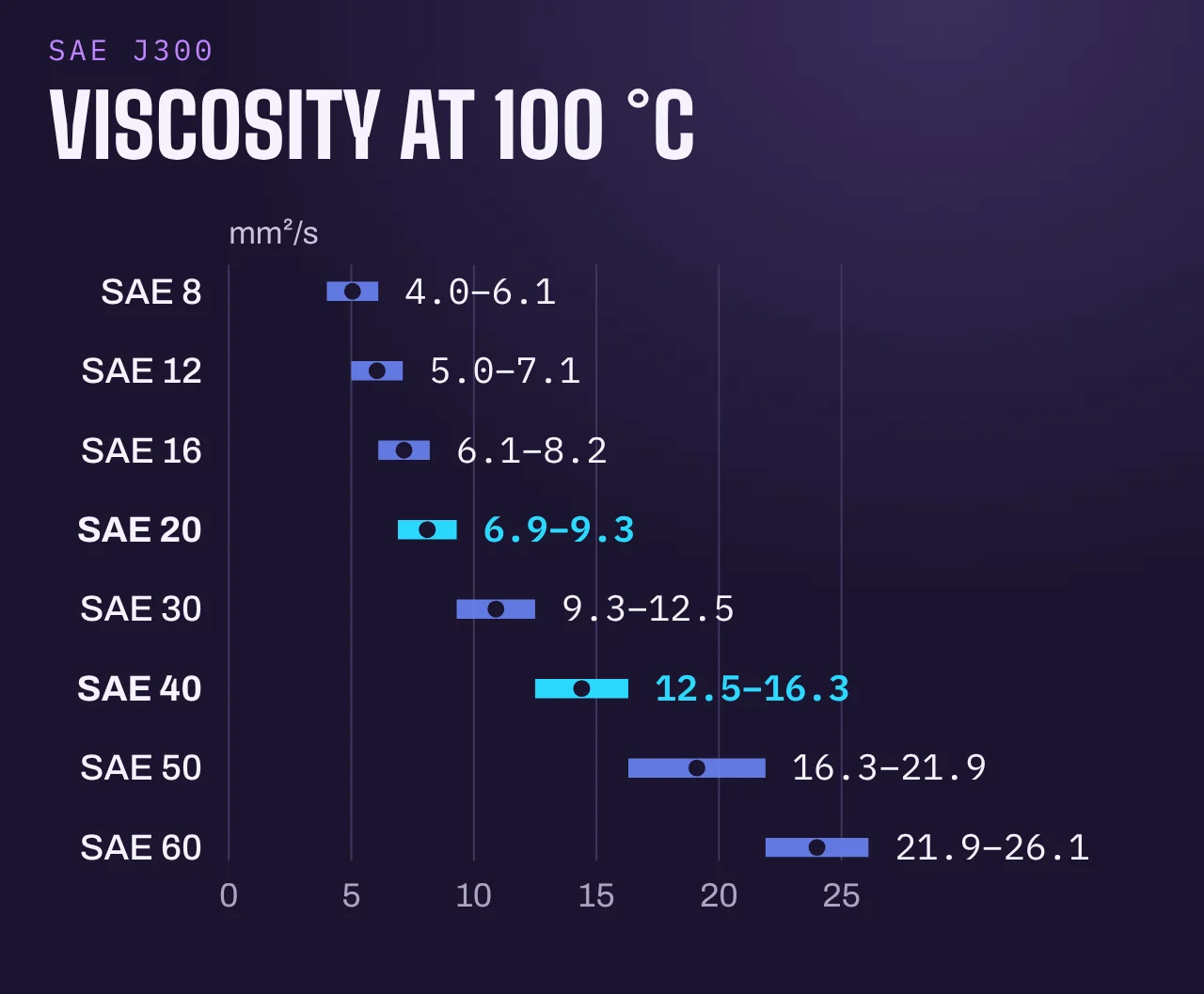
The windows get wider as the numbers rise, and the number climbs much faster than the viscosity. Measured at the middle of each window, an SAE 40 is about 1.8 times as thick as an SAE 20 — not twice.
The number on the bottle is a label, not a measurement. SAE 40 is not twice as thick as SAE 20.
Reading 0W-40 end to end
A 0W-40 has to meet both grades. Cold, it passes the cranking test at −35 °C and still pumps at −40 °C. Hot, it sits between 12.5 and 16.3 mm²/s at 100 °C, with at least 3.5 mPa·s HTHS.
A detail hardly anyone knows: for 15W-40, 20W-40 and straight SAE 40 the standard asks for 3.7 mPa·s HTHS, for 0W-40, 5W-40 and 10W-40 only 3.5. Two "40s" are not automatically equally strong.
The new thin grades: 16, 12 and 8
SAE 16 arrived in 2013, SAE 12 and SAE 8 followed in 2015. The SAE picked 16 on purpose so that future grades could count down in steps of four. The stated aim, in the SAE's own words: room for lower-HTHS oils that save fuel.
These are the first grades whose windows overlap. SAE 8 and SAE 12 share the range from 5.0 to 6.1 mm²/s, and only the HTHS minimum tells them apart.
Single-grade vs multigrade oil
A single-grade oil meets one grade, such as SAE 30 or SAE 20W. A multigrade oil meets a winter grade and a hot grade at the same time, so its viscosity has to swing much less with temperature.
The viscosity index
How much an oil thins with heat is described by the viscosity index (VI), calculated from the viscosity at 40 °C and at 100 °C. The higher the VI, the less the oil changes, as the STLE explains.
Typical values according to Anton Paar: mineral oil 95 to 105, PAO 135 to 160, esters 140 to 190, finished multigrade oils 140 to 200. A true multigrade, says Machinery Lubrication, has a VI of at least 120 and contains VI improvers or synthetic base oils.
How viscosity index improvers work
VI improvers are long polymer chains. In cold oil they sit coiled up; as the temperature rises they relax and stretch out, offsetting part of the thinning (STLE). They have been added to motor oil since the mid-1930s (Tribology Letters).
A common misunderstanding: a 10W-30 does not get thicker when warm. It simply thins less than a single-grade oil that flows the same way when cold.
Shear: the price you pay
The polymers have a weak spot. Under high stress they line up and briefly lose their effect, so the oil thins temporarily inside the bearing. That temporary shear recovers and even saves fuel, writes the STLE.
At cam lobes, tappets and heavily loaded gears the chains break for good. Then the oil drops out of its grade, and a 10W-30 behaves like a 10W-20. If used-oil analysis shows the viscosity at 100 °C down by more than 10 %, the STLE suggests shorter oil changes or a more shear-stable oil.
That is why oil makers talk about oils that "stay in grade": the oil remains within its grade over the whole oil change interval. The wider the gap between the two numbers — 0W-40, 5W-50 — the more work the base oil or the polymer has to do.
HTHS: the number behind real engine protection
HTHS viscosity (high temperature, high shear) tells you how thick the oil is where it matters: in the extreme heat of 150 °C, under extreme shear, in a tight bearing gap — the intense heat and load the internal components actually see. It is the best single figure for engine protection and fuel use at once, and it is not printed on the bottle.
The test simulates hot, fast-moving parts with tight clearances — crankshaft and con-rod bearings, cams, piston rings (STLE). The minimums in SAE J300:
- SAE 8: 1.7 mPa·s
- SAE 12: 2.0 mPa·s
- SAE 16: 2.3 mPa·s
- SAE 20: 2.6 mPa·s
- SAE 30: 2.9 mPa·s
- SAE 40: 3.5 mPa·s (0W-, 5W- and 10W-40) or 3.7 mPa·s (15W-, 20W-, 25W-40 and straight SAE 40)
- SAE 50 and 60: 3.7 mPa·s
Lower HTHS means less internal friction and less fuel burned. According to the STLE, moving a truck from a 15W-40 to a low-HTHS 5W-40 saves 0.5 to 1.5 % fuel. The same source warns that older engines are generally not compatible with low-HTHS oils.
The practical point: the second number is not enough. A 5W-30 made to ACEA A5/B5 may sit at 2.9 mPa·s HTHS, while a 5W-30 made to ACEA C3 must reach at least 3.5 (oilspecifications.org). Both bottles say 5W-30, yet in the hot bearing one is about 20 % more viscous than the other. The exact figure is on the oil maker's technical data sheet.
Base oils: what "fully synthetic" really means
The viscosity grade tells you nothing about what an oil is made of. That is decided by the base oil, which the American Petroleum Institute (API) sorts into five groups.
| Group | What it is | VI |
|---|---|---|
| I | conventional mineral oil | 80–119 |
| II | more heavily refined mineral oil | 80–119 |
| III | hydrocracked mineral oil | 120+ |
| IV | polyalphaolefins (PAO) | – |
| V | everything else: esters, naphthenics | – |
Part-synthetic oils, sold as synthetic blends, mix base oils from different groups. Groups I to III also differ in purity: Group I has under 90 % saturated hydrocarbons or over 0.03 % sulphur, while Groups II and III have at least 90 % saturates and no more than 0.03 % sulphur. Definitions by the API, as listed by ExxonMobil and Wikipedia.
The fight over the word "synthetic"
Until the late 1990s, "synthetic" in the oil business meant PAO. Then Castrol switched its Syntec to Group III base oil, and Mobil complained. In April 1999 the US National Advertising Division ruled that Castrol could keep calling the oil synthetic (STLE).
That opened the door to selling Group III oils as synthetic oil (Lubes'n'Greases). German parts sellers often list them as "HC-Synthese", hydrocracked synthetic. That is not a verdict on quality: the additives and the approvals tell you more about an oil than its base-oil group.
Why the base oil matters for viscosity
The higher the VI of the base oil, the less polymer a multigrade oil needs to span a range like 0W-40. Less polymer means less that shear can tear apart.
Esters are a special case. They are polar, cling to metal surfaces, evaporate little, dissolve additives well and help the engine's seals swell as intended, says the ester maker Teknor Apex. In motor oil they usually go in as a blend component alongside PAO or Group III.
Why older engines need thicker oil
A classic or youngtimer engine was designed around the oils of its day: larger bearing clearances, looser manufacturing tolerances, often flat tappets. It needs a thicker film than modern vehicles do. Typical oils for older cars, according to SlashGear, are 10W-30, 10W-40, 15W-40 and 20W-50.
Bearing clearance and high mileage
US engine builders work with a rule of thumb: 0.001 inch of bearing clearance per inch of journal diameter (EngineLabs). On a small-block Chevy that comes to about 0.0025 inch (0.064 mm), traditionally paired with 10W-30 or 10W-40.
From about 0.003 inch (0.076 mm) — a 455 Oldsmobile, for example — builders reach for 20W-50 to keep the film intact. Oil temperature matters too: according to the same source, thin oil at high temperatures, above about 225 °F (107 °C), can lead to accelerated wear in the bearings.
Back then, some clearances could be checked with a feeler gauge. Today CNC machining and laser measurement hold far tighter tolerances (MotorWeek). And an engine with high mileage has more clearance than it had when new — one more reason not to go thinner than the manual on an old engine.
What the experts say
The oil specialists asked by Classic Motorsports were close to unanimous: use the viscosity the manufacturer specified. If the manual says 20W-50, stay with 20W-50 unless the car lives in extreme cold.
Modern oils still protect old engines better than the oils of their era overall, writes Paul Ireland in Classic Engines, Modern Oil. Back then you ran a "winter grade" such as SAE 20W in the cold and an SAE 40 in summer; the same article notes that the old "temperate and tropical" oils grew far too viscous below 0 °C. Today one multigrade covers both — in the viscosity from the manual.
Zinc, phosphorus and flat tappets
The second reason for dedicated classic car oils is not viscosity but additives. ZDDP (zinc dialkyldithiophosphate) protects heavily loaded sliding contacts, above all cam lobes and the faces of flat tappets (AA1Car).
Because phosphorus harms catalytic converters, ZDDP was capped: no limit until 1996, then 1,000 ppm, and 800 ppm with API SM in 2004 (EngineLabs). After that last cut, flat-tappet camshaft failures piled up. The cap only applies to the fuel-economy grades, though; thicker oils such as 15W-40 have no API phosphorus limit (Lubes'n'Greases).
How much zinc a flat tappet really needs is disputed:
- For zinc: the parts retailer Speedway Motors calls 1,200 ppm the minimum for flat tappets, and wants more in any freshly built engine during break-in. Roller cams arrived at GM in 1987 and at Ford, in the Mustang, in 1985.
- Against: oil chemist Lake Speed Jr. says classic cars do not need high-zinc oil in normal running, and that modern API SP and SQ oils are fine for flat tappets. The detergent matters just as much: plenty of calcium works against the zinc film.
Break-in is a different story. In Speed's test with a fresh flat-tappet camshaft, an API SQ oil wore the lobes and the steel lifters heavily (EngineLabs). Bottled zinc additives were no reliable fix: they raised zinc and phosphorus unevenly, and one product with considerably more of both still failed to protect the cam.
Speed's conclusion: "Don't try to fix the wrong oil by blindly adding chemistry." A freshly rebuilt flat-tappet engine gets a proper break-in oil first, then oil in the viscosity from the manual.
Why modern engines run thinner oil
New engines are designed around thinner oil. It saves fuel, reaches every bearing faster after a start, and the oil hydraulics of modern passenger vehicles are tuned to it. The price is a smaller margin when something goes wrong.
Tighter tolerances
With CNC machining and laser measurement, parts fit far more precisely than they used to (MotorWeek). Thinner oil flows with less resistance into those tight gaps and protects sooner after a start (EngineLabs).
Thicker oil than specified is no bonus there. It flows more slowly through the bearings it is supposed to cool, and the engine parts run hotter, warns MotorWeek. In modern engines, the wrong oil is a problem in both directions.
Thin oil and fuel economy
The scale comes from a 2015 study by the US National Research Council on fuel-saving technology (National Academies). Engine friction eats about 8 % of the fuel's energy, which is why lower viscosity means better fuel economy: hydrodynamic lubrication accounts for about 3 %, and that loss grows with viscosity.
- 5W-30 to 5W-20: viscosity at 100 °C about 25 % lower, roughly 0.5 % less fuel.
- 5W-20 to 0W-20, 0W-16 or 0W-12: about 0.5 % from better cold behaviour, another 0.5 % if you go all the way to 0W-12, around 1 % in total.
In a test with two 1998 Buick Century sedans, 5W-20 instead of 5W-30 improved fuel economy by 1.0 to 2.2 % depending on the oil (SAE 2001-01-1900). In the cold-start phase no difference showed. A 2019 SAE paper adds a warning: whether there is any gain at all depends on the engine (SAE 2019-01-2241).
Oil as hydraulic fluid
In a modern engine the oil does not just lubricate, it actuates. Many manufacturers shift camshaft timing with oil pressure or oil flow. The wrong viscosity or old oil can therefore set variable valve timing fault codes, says a workshop bulletin from the Maryland Department of the Environment.
Hydraulic chain tensioners depend on the oil as well. According to the timing-drive maker Cloyes, tensioners and cam phasers are the parts most dependent on a good oil supply. If debris clogs their oil ports, the tensioner suffers oil starvation and the chain runs slack.
Turbos, direct injection and LSPI
Small turbocharged petrol engines with direct injection have a problem of their own: LSPI, low-speed pre-ignition. At low revs and high load the mixture ignites too early, and the pressure spikes can cause serious engine damage: cracked pistons and bent con rods (EV Powered).
The oil plays a part: industry tests show that high levels of calcium-based detergent raise the risk. Since API SP and ILSAC GF-6 the standards test for LSPI and timing-chain wear, and since March 2025 API SQ also tests with aged oil (oilspecifications.org). That has little to do with viscosity and everything to do with the right specification.
High mileage and oil consumption: when thicker oil makes sense
Mileage alone is no reason to move a modern engine to thicker oil. At 200,000 or 300,000 km it stays on the grade from the manual — unless the wear really shows, and then it usually shows as oil consumption.
Oil makers agree on the first part. Petro-Canada calls the belief that high-mileage engines need a higher viscosity a common myth: the oil should always be the one in the manufacturer's manual. TotalEnergies writes that high mileage should not be a reason to change the viscosity grade on your own. The engine's hydraulics also stay tuned to thin oil for life; variable valve timing and chain tensioners do not change with the odometer.
What long-term tests show
The evidence is not one-sided:
- In an SAE fleet test, taxis ran 100,000 miles (about 160,000 km) on 0W-20 and 5W-20. After teardown, both oils were rated equivalent and acceptable (SAE 2005-01-3818).
- In an older field test with 45 New York taxis, there were many cases of very high bearing wear with the thinnest oils and none with the thicker ones (SAE 922342).
- The margin depends on temperature: at 90 °C oil temperature, ring and cam wear did not rise even at 2.2 mPa·s HTHS, while at 130 °C it rose below 2.4 mPa·s (SAE 932782).
Where the wear shows
At high mileage, wear rarely announces itself in the bearings first. It shows as oil consumption and leaks: worn or stuck piston rings and worn valve stem seals let oil into the combustion chamber (AMSOIL). That is where thicker oil has a case. If a heavily worn engine burns oil with blue smoke, a higher viscosity may help reduce consumption, says a car-care column in the Dayton Daily News — while reminding readers that the engine was designed for the specified viscosity.
What to do instead
- Stay on the grade from the manual as long as the engine is tight and uses no oil.
- Use the alternatives the maker allows. Some engines may run, say, 0W-20 or 5W-30 depending on the climate (Jalopnik); if the manual lists a thicker alternative, that is the legitimate step up.
- Try a high-mileage oil in the same viscosity. Its seal conditioners make O-rings, gaskets and seals swell, and with older valve stem seals that can lower oil consumption (Machinery Lubrication).
- Shorten the oil change interval and have the used oil analysed to see whether it still holds its grade.
The case everyone quotes is GM's 6.2-litre L87 V8. In the recall of 2021 to 2024 models over manufacturing defects, engines that pass inspection get 0W-40 instead of 0W-20 (GM Authority). New replacement engines stay on 0W-20 (Autoblog). Thicker oil can relieve a marginal bearing, but that decision belongs to the manufacturer, not to the odometer.
Engine oil specifications beat the viscosity grade
Viscosity says how thick an oil is. Specifications and approvals say what it can do: wear protection, cleanliness, compatibility with particulate filters and catalytic converters. When you buy engine oil, find the approval in the vehicle owner's manual first and the viscosity second.
API and ILSAC
The API system comes from the US. "S" stands for spark-ignition engines; the current level is API SQ, in force since 31 March 2025 as the successor to SP. ILSAC GF-7 started the same day in two versions (Infineum):
- GF-7A with the round "starburst" mark, for the usual fuel-economy grades such as 0W-20 or 5W-30, not for 0W-16.
- GF-7B with the shield mark, for 0W-16 only.
Since 31 March 2026, GF-6 oils may no longer carry these marks. For truck diesels the API also splits by HTHS: CK-4 has at least 3.5 mPa·s, the more economical FA-4 only 2.9 to 3.2 (Precision Lubrication).
ACEA: the European system
Europe uses the ACEA oil sequences, currently in their 2023 edition. A/B classes are "high SAPS", with plenty of sulphated ash, phosphorus and sulphur. C classes contain less and are made for particulate filters and catalytic converters.
| ACEA | HTHS (mPa·s) | Ash (SAPS) |
|---|---|---|
| A3/B4 | 3.5+ | high |
| A5/B5 | 2.9–3.5 | high |
| A7/B7 | 2.9–3.5 | high |
| C2 | 2.9+ | mid |
| C3 | 3.5+ | mid |
| C4 | 3.5+ | low |
| C5 | 2.6+ | mid |
| C6 | 2.6+ | mid |
| C7 | 2.3–2.6 | mid |
Values from oilspecifications.org, C7 from Lubrizol. A7/B7 and C6 add protection against LSPI and turbocharger deposits; C7 is a 0W-16 class for engines approved for it.
The numbers are not a ranking. A C6 is not "better" than a C3, and a C7 may only replace a C3 if the vehicle manufacturer explicitly allows it (oilspecifications.org).
Owner's manual, oil cap and approvals
The recommended viscosity grade is usually printed on the oil filler cap as well as in the owner's manual, notes the Maryland Department of the Environment. The oil cap gives you the grade; the manual gives you the approval. In the end, the vehicle manufacturer's approval counts. The data sheet of Mobil 1 ESP x2 0W-20 shows how to read one: under approvals it lists VW 508 00/509 00, MB 229.71 and Porsche C20, and below that come specifications the oil merely "meets" by its maker's own account. An approval has been checked by the carmaker; "meets" is the oil company's claim.
How tight this gets shows in BMW Longlife-17 FE+. According to Motul, it is a 0W-20 with strongly lowered HTHS for certain BMW petrol engines from 2017 with a petrol particulate filter, and not for M engines. The same "0W-20" on the bottle can be right for one BMW and wrong for another.
Pros and cons of each motor oil viscosity grade
Every grade is a trade-off between cold start, film thickness and friction. The engine decides which one fits, not taste.
- 0W-8 to 0W-16: the newest fuel-saving petrol engines with an explicit approval. Lowest friction and the fastest oil supply after a start; the smallest HTHS margin, so never without the approval.
- 0W-20, 5W-20: current petrol engines with approvals such as VW 508 00 or MB 229.71. Saves a little fuel over a 30 grade and starts very well in the cold; too thin for older or heavily loaded engines without the approval.
- 0W-30, 5W-30: many petrol and diesel cars, including those with particulate filters. The middle ground between cold start and film thickness; HTHS is 2.9 or at least 3.5 depending on the specification, so the approval decides.
- 0W-40, 5W-40: powerful engines and approvals that call for high HTHS. A thick film when hot and still a good cold start; more friction, and the wide span needs a shear-stable oil.
- 10W-40, 15W-40: youngtimers, older cars and many commercial diesels. A robust film for larger bearing clearances and no API phosphorus cap; a slower cold start and more fuel.
- 20W-50: classics with large clearances that see high temperatures. A thick film where modern oils would be too thin; the cranking test only goes down to −15 °C, and it is wrong in a modern engine.
- SAE 30, SAE 40: very old engines, when the manual calls for them. No VI polymers that can shear; good for one temperature range only, and very stiff when cold.
Five rules for the oil shelf
- Approval first, number second. The owner's manual names the specification or carmaker approval the engine needs. The viscosity follows from it, and that is how you find the right motor oil.
- Before the W is cold, after the dash is hot. 0W means the oil passes its cranking test at −35 °C and its pumping test at −40 °C. The 40 means 12.5 to 16.3 mm²/s at 100 °C.
- HTHS is the hidden protection figure. Two oils with the same grade can carry different loads in the bearing; the data sheet tells you which.
- Old engines get what they were built for. Usually 10W-40 to 20W-50, with an eye on the additives for flat tappets and a break-in oil for a fresh rebuild.
- New engines get thin oil — but only the approved one. There, 0W-20 or 0W-16 is part of the design, not penny-pinching.
Oil is not the only fluid with an expiry date most people ignore. Brake fluid ages by the calendar rather than the odometer — here is why it has to be changed.
FAQ
What does the W in 0W-40 stand for?
Winter. The number in front of it says down to which temperature the oil passes the cold-cranking and pumping tests of SAE J300; for 0W that is −35 °C and −40 °C. It is not a thickness rating and has nothing to do with "weight".
What does 5W-30 mean?
The 5W means the oil passes the SAE J300 cranking test at −30 °C and still pumps at −35 °C. The 30 means a kinematic viscosity of 9.3 to 12.5 mm²/s at 100 °C and at least 2.9 mPa·s HTHS at 150 °C. Whether a particular 5W-30 suits your engine depends on its specification: an ACEA C3 5W-30 must reach 3.5 mPa·s HTHS, an A5/B5 5W-30 may sit at 2.9.
Is 0W-40 the same as SAE 40?
When hot, both sit in the same window of 12.5 to 16.3 mm²/s at 100 °C, but the straight SAE 40 needs at least 3.7 mPa·s HTHS against 3.5 for the 0W-40. When cold, they are worlds apart: the 0W-40 passes the cranking test at −35 °C, while a single-grade SAE 40 carries no winter rating at all.
Is 0W-40 thicker than 5W-30?
When hot, yes: a 40 sits between 12.5 and 16.3 mm²/s at 100 °C, a 30 between 9.3 and 12.5. When cold, the 0W-40 passes the tougher test, with its cranking test at −35 °C instead of −30 °C. A 0W does not mean thin at room temperature.
Which is thicker, 5W-30 or 10W-30?
At operating temperatures they share the same window of 9.3 to 12.5 mm²/s at 100 °C. The difference is the cold end: the 5W-30 passes its cranking test at −30 °C, the 10W-30 only at −25 °C, so the 5W-30 is the one that flows better at low temperatures.
Is thicker oil better for an engine?
Only in an engine built for it. In a modern engine, thicker oil flows more slowly through the bearings it should cool, so the parts run hotter (MotorWeek); it adds friction and can upset valve timing that runs on oil pressure. In an old engine with large bearing clearances, the thicker grade from the manual is exactly right.
Can I use 5W-40 instead of 5W-30?
Only if the owner's manual or the carmaker's approval allows it. In an engine designed for a 30 grade, a higher viscosity grade adds friction, flows more slowly through bearings built for thinner oil and can upset valve timing that runs on oil pressure. If the manual lists both grades, either is fine; if you are unsure, ask a qualified mechanic rather than guessing.
Is 0W-20 too thin for an older engine?
Usually yes, if the engine was never designed for it. Older engines have larger bearing clearances and, according to the STLE, are generally not compatible with low-HTHS oils. Stay with the grade in the manual, which for classics typically lies between 10W-40 and 20W-50.
Does a high-mileage engine need thicker oil?
Not because of the odometer. As long as the engine is tight and uses no oil, it stays on the grade from the manual. If it starts burning oil, a thicker grade the manual allows or a high-mileage oil in the same viscosity are the first steps to try.
Can I mix two different engine oils?
For a top-up, yes. To earn API SQ, an oil has to stay homogeneous and miscible when mixed with reference oils (Infineum). Use one with the same approval if you can; for the long run, oil makers such as Repsol advise against a permanent mix.
Is a 75W-90 gear oil thicker than a 10W-40 engine oil?
Not necessarily. Gear oils are graded under a separate standard, SAE J306, so their numbers cannot be compared with motor oil grades (Wikipedia).
How often should a classic car get fresh oil?
An oil specialist asked by Classic Motorsports recommends every 3,000 miles (about 4,800 km) or once a year, whichever comes first — so a car that barely moves still gets its oil changed every year.
Written from the SAE, API and ACEA standards, technical literature and oil makers' data sheets, not from testing of our own. Standards as of November 2026. Sources: SAE J300 (SAE) · SAE J300 grade table (Wikipedia) · STLE on HTHS and shear stability · STLE on VI improvers · ACEA classes (oilspecifications.org) · ACEA 2023 and C7 (Lubrizol) · ILSAC GF-7 (Infineum) · National Research Council 2015 on engine friction · EngineLabs on bearing clearances · EngineLabs on zinc and classic cars · Lubes'n'Greases on phosphorus limits · Mobil 1 ESP x2 0W-20 data sheet · Motul data sheet with BMW LL-17 FE+ · Petro-Canada on high-mileage oil · SAE 2005-01-3818, 0W-20 in taxi fleet service · SAE 922342, viscosity and bearing wear in taxis · SAE 932782, viscosity and ring and cam wear · GM Authority on the L87 recall