“Why do you have to change brake fluid every two years?”
Why brake fluid goes off.
Not condensation. Brake fluid pulls water out of the air on purpose — and that water ends up exactly where the heat is, down at the caliper.
The short answer
- Glycol-ether brake fluid is hygroscopic by design, because water spread thinly through the whole volume is safer than one free droplet sitting in a bore.
- Water does not soften the pedal by being compressible. It softens the pedal by boiling into steam, which is.
- A study of 100 cars found reservoir fluid boiling up to 20 °C higher than fluid from the same car's caliper — so a reservoir-only test can pass a car that would fail at the wheel.
The service interval for brake fluid is written in years, not kilometres, and that is the whole clue. Mileage barely touches it. What ages brake fluid is time, humidity and the fact that the stuff is designed — deliberately, by the people who formulate it — to soak up water.
The usual explanation involves condensation forming inside a hot brake system. That is wrong, and it is wrong in a way that is worth understanding, because the real mechanism tells you where to look.
The fluid drinks water on purpose
DOT 3, DOT 4 and DOT 5.1 are all built on glycol ethers, usually with borate esters blended in to lift the boiling point. Glycol ethers are hygroscopic: they pull water molecules out of the air and bind them chemically. This is not a flaw nobody managed to engineer out. It is the specification.
The alternative is worse. A fluid that rejected water would leave every drop that got in as a drop — free water, running to the lowest point in the system, freezing in winter and rusting a bore from the inside at one spot. A hygroscopic fluid takes that same water and disperses it through the entire volume, molecule by molecule. No puddles, no ice, no single corroded pit.
The price is that the whole volume degrades a little instead of one spot degrading catastrophically. That is the bargain the standard was written around, and it is a good bargain — right up until you stop paying for it.
Where the water gets in
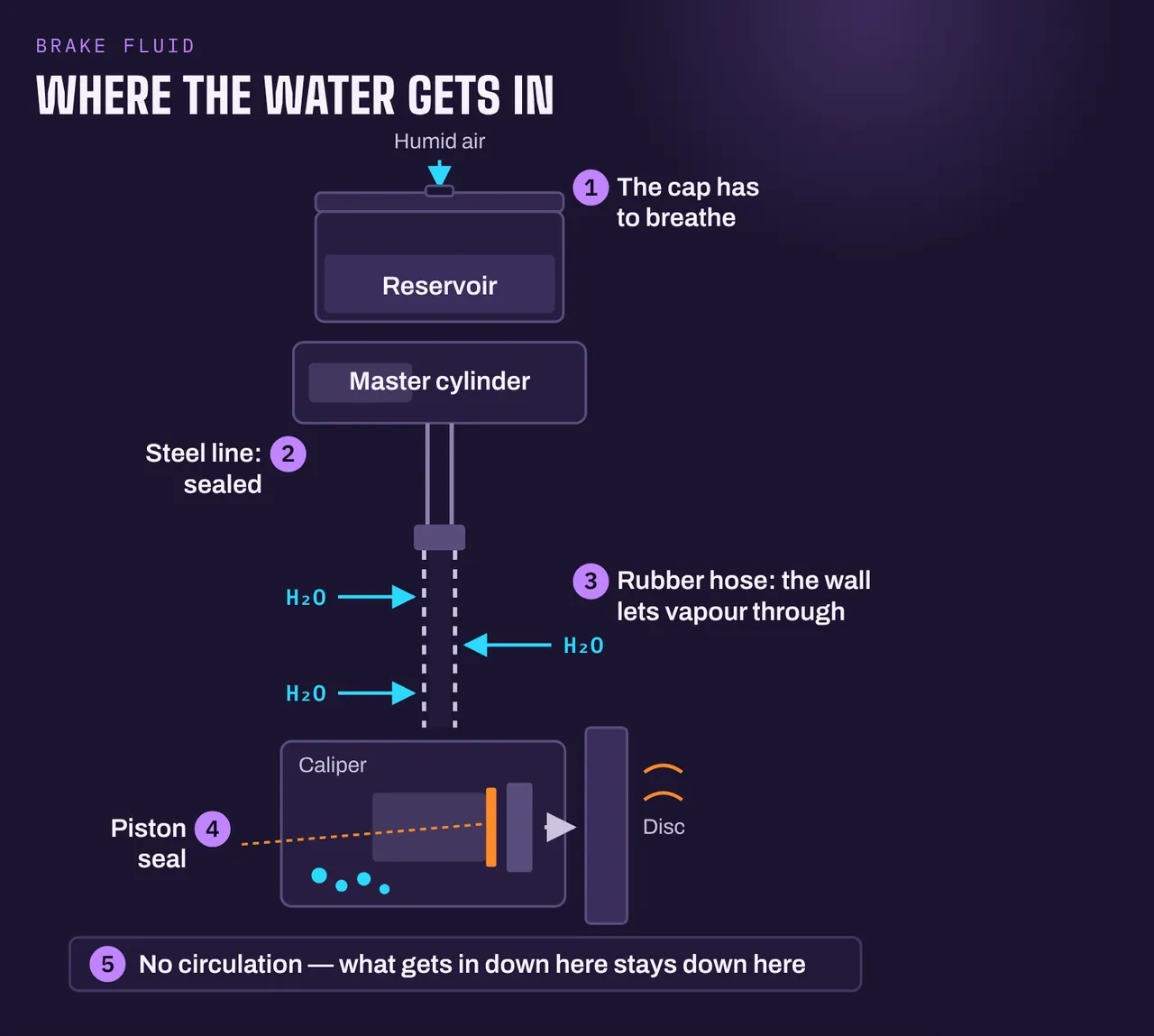
Three routes, and the order matters.
The rubber hoses. Rubber is not a vapour barrier. Volvo's patent on estimating brake-fluid water content describes water permeating straight through the walls of the flexible brake hoses, at a rate that climbs with both temperature and air humidity — which is why a car kept near the coast takes up water many times faster than one inland. A typical hose runs about half a metre, and there are four of them, each hanging right next to a wheel.
The reservoir. It has to breathe. As the pads wear, the fluid level drops and something has to occupy the space above it. Whatever seal or membrane the cap uses, the reservoir is open to atmosphere by design.
The caliper seals. The same patent names a seal in the caliper as a further way in.
Then comes the detail that makes all of it matter: brake fluid does not circulate. There is no pump and no return path. Volvo's engineers state it plainly — water entering at or near the calipers can be assumed to stay there. Press the pedal and a few millilitres shuffle down and back. That is the extent of the mixing.
So water that arrives at the bottom of the system stays at the bottom of the system. Which would be fine, except that the bottom of the system is the hot end.
Liquid water is harmless. Steam is not.

This is where the car-park explanation falls apart.
Water in the lines does not soften the pedal because water is compressible. It isn't. Liquid water is, for any pressure a brake system produces, as incompressible as the fluid around it. If that water just sat there as a liquid, you would never feel it — not on the pedal, not anywhere.
What matters is the temperature at which it stops being a liquid.
A brake turns motion into heat at the disc, and some of that heat travels straight back through the pad and the piston into the fluid behind it. Volvo's patent describes the caliper as the component most exposed to heat, and the fluid there as the fluid most likely to boil. Reach that boiling point and the water flashes to steam — and steam compresses beautifully.
Press the pedal now and the force goes into squashing a gas bubble instead of driving a piston. The pedal travels, the pad never arrives. That is vapour lock, and it gives no warning: the brakes are normal for the first four hairpins of an Alpine descent and then they are not.
It is not that water is compressible. It is that water turns into something that is.
What 3.7 percent costs you
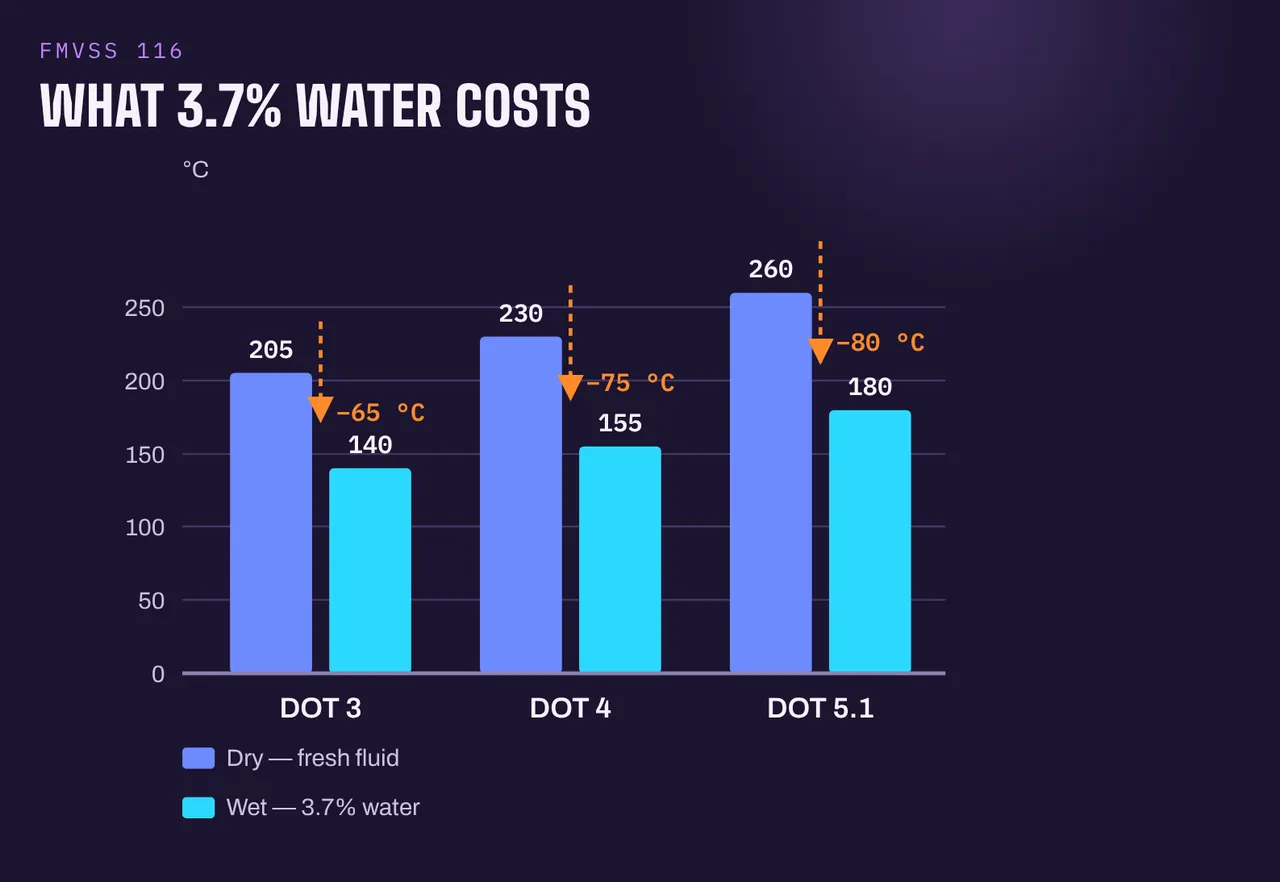
FMVSS 116, the US federal standard behind the DOT grades, fixes two numbers for each one. The dry boiling point is fresh fluid from a sealed bottle. The wet boiling point is the same fluid carrying 3.7 percent water — the level the standard treats as the end of its usable life.
| Grade | Dry | Wet (3.7%) |
|---|---|---|
| DOT 3 | 205 °C | 140 °C |
| DOT 4 | 230 °C | 155 °C |
| DOT 5.1 | 260 °C | 180 °C |
Look at which way the losses run: 65, 75 and 80 degrees. The better fluids do not merely start higher, they have more to lose — the borate esters that raise the dry boiling point also give the fluid a keener appetite for water. Fitting DOT 5.1 and then forgetting about it for six years leaves you worse off than DOT 4 changed on time.
Volvo puts a water content of two to four percent in the range where ordinary operating temperatures can reach the wet boiling point, and notes that normal use takes several years to get there. Two years as an interval is not a cliff edge on the second anniversary. It is the margin.
Water does quieter damage on the way, too. It worsens low-temperature viscosity, which is what ABS and ESP have to pump through on a cold morning, and it eats into the fluid's corrosion protection and its compatibility with the rubber seals it spends its life touching.
The test most garages get wrong
Here is the part worth knowing if someone else checks your car.
The standard check is a probe dipped into the reservoir. The reservoir is also the one place in the system where the fluid is newest, coolest, furthest from the hoses and most likely to have been topped up at some point. It is the most flattering sample you could possibly take.
Branislav Šarkan and colleagues at the University of Žilina published a study in Acta Technologica Agriculturae in 2025 that measured boiling point directly, with a Bosch BFT 100 on 30 ml samples, across 100 vehicles of varying age and mileage. On 39 of those cars they drew samples from two places: the reservoir and the caliper.
Reservoir fluid boiled higher than caliper fluid, by as much as 20 °C in individual cars. Of the 39, 59 percent were satisfactory at both points and 28 percent failed at both. The remaining 13 percent met the standard in the reservoir and failed at the caliper.
That last group is the point of this article. Those are cars whose owners would have been told the brake fluid was fine.
Older cars and higher-mileage cars showed lower boiling points, which is no surprise. The useful finding is the other one: a reservoir-only check misses roughly one car in eight. If you want a real answer, ask for a boiling-point measurement taken at a caliper bleed nipple. A conductivity pen infers water from an electrical property of the fluid; a boiling-point tester heats the sample until it actually boils and reports the temperature — which is the number that decides whether your pedal goes hard or soft.
And before anyone suggests DOT 5
Silicone-based DOT 5 really is not hygroscopic, and that does not solve the problem so much as swap it for a nastier one. Silicone fluid is immiscible with water: anything that gets in stays as free water, collecting at the lowest point and boiling at 100 °C instead of 180. Silicone is also more compressible than glycol fluid, which on its own gives a softer pedal. It does not mix with DOT 3, 4 or 5.1 and must never be poured into a system built for them.
FAQ
Does mileage matter at all, or only time?
Mostly time. Water enters by permeation and by the reservoir breathing, and both run on the calendar and the local humidity rather than on distance covered. A car that sits does not escape it. Heavy use adds a second problem — heat cycling and thermal stress on the fluid — but the two-year interval exists because of the first mechanism.
Can I just top the reservoir up instead?
No. Fresh fluid poured into the reservoir stays near the reservoir, because nothing circulates it. The water is concentrated at the far end of the system, at the calipers, which is precisely where topping up cannot reach. Only a proper bleed pushes old fluid out at each wheel.
Is DOT 4 better than DOT 3 for a road car?
It starts higher and it falls further, so the honest answer is that the interval matters more than the grade. Use whatever the manufacturer specifies — going up a grade is usually safe, going down is not — and change it on schedule. A DOT 4 system filled with four-year-old DOT 4 is worse off than a DOT 3 system that was bled last spring.
Can I feel old brake fluid from the driver's seat?
Normally not, and that is the hazard. Degraded fluid behaves exactly like fresh fluid until the moment the caliper gets hot enough to boil it, at which point the pedal goes long without warning. Long descents, towing and track days are where it shows up. A soft pedal when the brakes are cold is a different fault — air, a leak or a failing master cylinder — and needs looking at immediately.
Does clear fluid mean good fluid?
No. Colour tracks age and contamination loosely at best, and the fluid you can see in the reservoir is the freshest in the car. Plenty of systems look clean in the reservoir and come out dark at the bleed nipple. Boiling point is the only measurement that answers the question.
Written from the published standard and peer-reviewed measurements, not from testing of our own. Sources: FMVSS 116, 49 CFR 571.116 · Šarkan, Loman, Kosiba & Paumer, "Measurement of Brake Fluid Boiling Point", Acta Technologica Agriculturae 2/2025 · Volvo Car Corporation, US 11,433,868 B2, determining water content in brake fluid · Brake fluid grades and properties